Generative AI Vs AI Agents Vs Agentic AI Explained
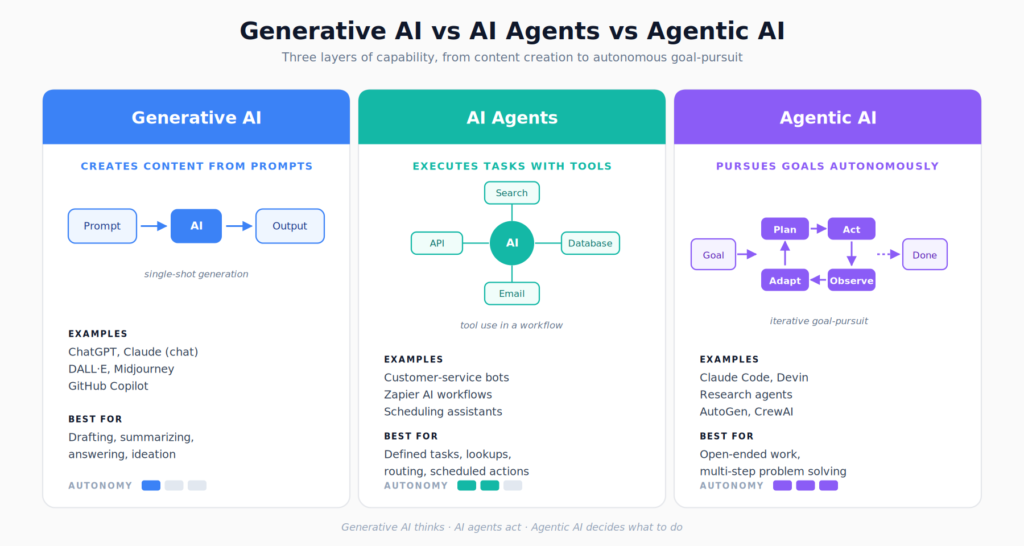
The AI world has gotten noisy. Every product is suddenly “agentic,” every chatbot is an “agent,” and “generative AI” is splashed across half the homepages on the internet. But these terms aren’t interchangeable — they describe three meaningfully different kinds of systems, each with different capabilities, costs, and risks.
Here’s a clear breakdown of what each one actually means, with examples you’ve probably used.
Generative AI: The Content Creator
Generative AI refers to models trained to produce new content — text, images, code, audio, or video — based on patterns they learned during training. You give it a prompt, it gives you an output. That’s the core loop.
How it works: A single forward pass through a model. You ask, it answers. There’s no planning, no tool use, no memory of what to do next.
What it’s good at:
- Drafting articles, emails, code snippets
- Generating images, music, or video clips
- Summarizing or translating content
- Answering questions from its training data
Examples: ChatGPT in basic chat mode, Claude answering questions, DALL·E, Midjourney, GitHub Copilot’s inline suggestions.
The limit: A generative model on its own doesn’t do anything in the world. It produces text or pixels. Ask it to “book a flight” and it can describe how — it can’t actually book one.
AI Agents: The Task Executors
An AI agent wraps a generative model with the ability to take actions, usually by calling external tools, APIs, or functions. The model decides which tool to call and what to pass to it, then uses the result to continue.
How it works: Prompt → model reasons → model picks a tool → tool runs → result feeds back → model produces an answer or picks the next tool. This typically happens inside a relatively constrained loop, often within a predefined workflow.
What it’s good at:
- Looking up live data (weather, stock prices, your calendar)
- Performing well-defined tasks (creating a Jira ticket, sending a Slack message)
- Multi-step workflows where the steps are reasonably predictable
Examples: A customer-service bot that checks your order status, a Zapier-style AI workflow, a Slack assistant that schedules meetings, an LLM with a web-search tool wired in.
The limit: Most agents today operate inside guardrails someone designed for them. They’re great at executing tasks but typically aren’t trusted to set their own goals or recover gracefully when things go off-script.
Agentic AI: The Autonomous Worker
“Agentic AI” describes systems with significantly more autonomy. They don’t just execute tasks — they pursue goals. They plan, adapt, self-correct, and often coordinate multiple sub-agents or tools across long-horizon work.
How it works: You give it a goal — “research the top three competitors in our market and draft a comparison memo.” The system breaks the goal into steps, decides which to run in parallel, evaluates intermediate results, retries when something fails, and decides when it’s done.
What it’s good at:
- Open-ended research and synthesis
- Long-running coding tasks (refactoring or debugging across files)
- Multi-tool workflows where the path isn’t known up front
- Orchestrating other agents
Examples: Claude Code autonomously editing codebases, Devin and similar coding agents, autonomous research assistants, multi-agent systems like AutoGen or CrewAI in their more open-ended configurations.
The limit: Higher autonomy means higher stakes when something goes wrong. Agentic systems can take meaningful real-world actions — spending money, sending emails, modifying production code — so they require careful design, observability, and clear permission boundaries.
A Quick Way to Remember the Difference
| Generative AI | AI Agents | Agentic AI | |
|---|---|---|---|
| Core capability | Creates content | Executes tasks | Pursues goals |
| Input | Prompt | Task | Objective |
| Autonomy | None | Low–medium | Medium–high |
| Tool use | No | Yes, scripted | Yes, self-directed |
| Best for | Drafting & ideation | Defined workflows | Open-ended problem solving |
A useful mental model: generative AI thinks, AI agents act, and agentic AI decides what to do.
Why This Distinction Matters
If you’re picking an AI tool for your business, the right category depends on the job:
- Need to draft a marketing email? Generative AI is enough.
- Need to triage incoming support tickets and route them? An AI agent with the right tools.
- Need a system that can investigate a customer issue across five internal apps and write a resolution plan? You’re in agentic AI territory — and you need to think hard about guardrails.
The further right you go on this spectrum, the more powerful the system gets, but the more deliberate you need to be about permissions, observability, and human review. Agentic AI is exciting precisely because it can do more without you, which means it can also go wrong without you.
The Bottom Line
These aren’t competing technologies — they’re a stack. Agentic AI is built on AI agents, which are built on generative models. Understanding the layers helps you pick the right tool for the right problem, set realistic expectations, and design appropriate safeguards.
The most useful AI products of the next few years probably won’t be “the best chatbot.” They’ll be agentic systems that quietly take work off your plate — drafting, executing, deciding — while you focus on the parts that genuinely need a human.